Share the details of your project like scope,
timeframes, or business challenges. Our team will thoroughly review the materials and respond to you promptly.
Thank You!
Your message has been received. Our team will get back to you shortly.
13 Aug 2026
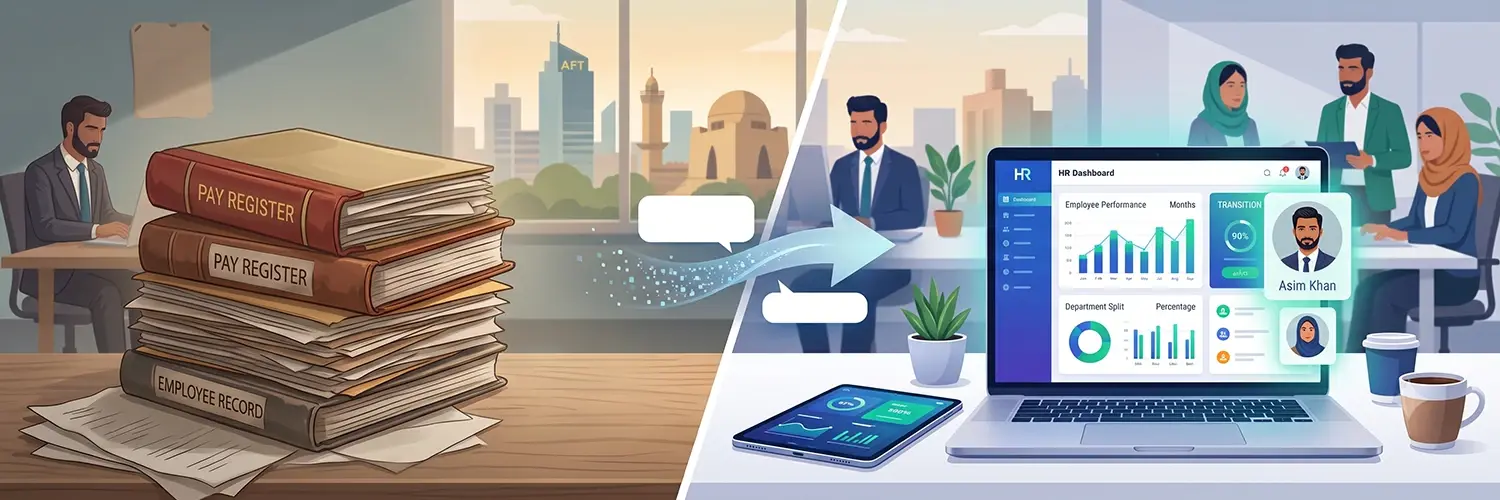
Why Pakistani SMEs Are Switching from Manual HR to HRIS Software in 2026
For Pakistani SMEs, manual HR processes can become difficult to manage as teams grow, payroll gets more complex and businesses add branches. Excel sheets, paper registers and disconnected attendance tools create repetitive work and make it harder to maintain accurate employee records. In 2026, HRIS Software gives growing businesses a way to centralize employee data, automate routine HR tasks and improve visibility across payroll, attendance, leave and workforce management.
HRIS Software, or Human Resources Information System software, is a centralized platform for managing employee records, payroll processing, attendance, leave and related HR workflows. Instead of maintaining separate spreadsheets, registers and files, an HRIS brings core employee information into one structured digital system.
Modern platforms can also connect biometric attendance, support employee self-service, automate payroll calculations and generate workforce reports. For a growing SME, this creates a single source of information instead of disconnected HR processes.
Why Manual HR Is Becoming a Problem for Pakistani SMEs
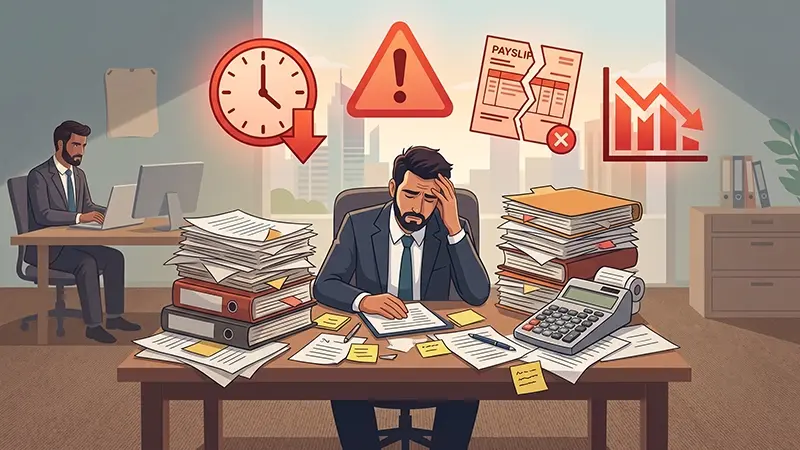
Manual HR becomes harder to manage when a business outgrows processes designed for a smaller team.
Why manual HR is becoming a problem for Pakistani SMEs as they scale.
Payroll Errors and Time-Consuming Processing
Manual salary calculations, allowances, deductions, overtime and attendance adjustments require repeated data entry and checking. Industry estimates often place payroll leakage from errors and process gaps at around 5% to 10%, although the actual impact varies by business.
For a 100-person team, payroll can consume 20 to 30 hours a month when attendance, leave and salary calculations are handled manually. Automating these processes can significantly reduce repetitive administrative work.
Attendance and Leave Disputes
Paper registers and disconnected attendance software make it difficult to maintain clear records of late arrivals, absences, overtime, half-days and leave balances. Biometric attendance can capture time from supported devices, while leave management workflows can record requests, approvals and balances in one system.
Multi-Branch Complexity
Businesses with several branches may maintain separate attendance records, employee files and payroll inputs. Consolidating this information manually slows reporting and increases the chance of inconsistencies.
A centralized HR system can provide better workforce management across locations while giving authorized users access to consistent employee records.
Compliance and Reporting
Payroll, tax deductions and internal employee records need to remain consistent and traceable. Digital records make information easier to retrieve, review and maintain in an audit-ready format.
Changing Employee Expectations
Employees increasingly expect digital pay slips, faster leave approvals and access to their own attendance and HR information instead of relying on HR for every request.
What an HRIS Can Automate
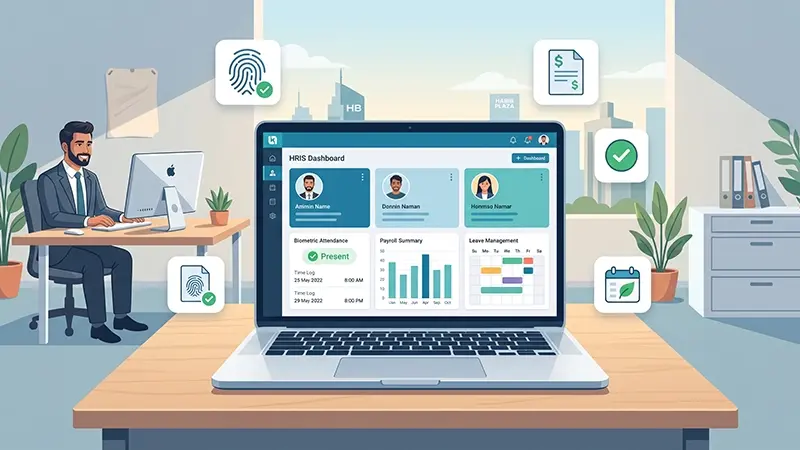
An HR system connects processes that are often separated in manual HR.
Employee Management
A centralized database organizes employee records, departments and organizational roles, while role-based access controls what different users can view or manage.
Biometric Attendance
Biometric attendance can capture clock-ins from supported devices and feed attendance information into reporting and payroll workflows.
Leave Management
Digital leave management handles requests, approvals, balances and policies without relying on paper forms or separate spreadsheets.
Payroll Automation
Payroll automation can calculate salaries, deductions, taxes, allowances and pay slips according to configured rules, reducing repeated manual data entry and payroll processing time.
Workforce Management and Reporting
Attendance summaries, absence trends, overtime information and KPI tracking can help managers understand staffing patterns and make better workforce decisions.
Employee Self-Service
Employees can view pay slips, attendance and leave balances and submit requests without routing every routine task through HR.
What Pakistani SMEs Should Look for in HRIS Software
Choosing HRIS Software should be about solving actual business problems rather than selecting the platform with the longest feature list.
Local Payroll Support
The system should support the payroll calculations, deductions and rules required for the company's Pakistani operations.
Attendance Integration
Businesses already using biometric attendance devices should confirm that their required devices can be integrated with the HR platform.
Multi-Branch Capability
Growing organizations need centralized employee records and reporting across branches, departments and locations.
Role-Based Access
Different users should have appropriate access to sensitive employee information, helping businesses maintain control over who can view or change HR data.
Audit-Ready Records
Payroll history, attendance data and reports should be easy to retrieve, review and reconcile when required.
Cloud-Based HRIS
A Cloud-based HRIS can benefit businesses with multiple locations or managers who need remote access, although the right deployment model should still reflect the company's security, connectivity and operational requirements.
HRIS vs HRMS: What's the Difference?
HRIS and HRMS are often used interchangeably and software vendors do not always define them in exactly the same way.
Generally, HRIS focuses on core HR information and processes such as employee records, payroll, attendance and leave, while HRMS may describe a broader system covering more of the employee lifecycle, including recruitment, performance and analytics.
For most SMEs, the more important question is whether the platform provides the employee management, payroll processing, attendance, employee self-service and reporting capabilities the business actually needs.
Signs Your SME Is Ready to Switch
Your business may be ready for HRIS Software if:
• Payroll takes more than two days each cycle to complete accurately.
• Attendance disputes over overtime, half-days or absences are becoming common.
• Employees regularly ask HR for pay slips, leave balances or attendance records.
• The business is expanding to multiple branches or cities.
• Compliance and audit preparation require significant manual effort.
• HR spends more time entering data than managing people.
• Management cannot get a reliable workforce report when needed.
• Existing spreadsheets or attendance software no longer scale with the business.
If several of these issues are already affecting operations, a digital HR system may be more practical than continuing to patch manual processes.
How to Move from Manual HR to HRIS
A structured migration can reduce disruption and improve adoption.
1. Clean Employee Records
Remove duplicate, incomplete or outdated information before moving employee data into the new system.
2. Document HR Policies
Confirm payroll, leave, attendance, overtime and approval rules before configuring the platform.
3. Connect Attendance Devices
Integrate existing biometric devices where supported and verify that attendance logs are syncing correctly.
4. Configure Access
Set role-based access for HR, finance, managers and employees according to their responsibilities.
5. Test Payroll
Run sample payroll calculations and reconcile them with existing records before the first live payroll cycle.
6. Train Users
Make sure HR staff, managers and employees understand the new workflows and self-service features.
7. Go Live and Review
Monitor the first few payroll and attendance cycles and correct configuration issues before fully retiring manual processes.
Common Mistakes When Choosing HR Software
The lowest price is not always the lowest total cost.
Common mistakes Pakistani SMEs make when choosing HR software.
SMEs should avoid software without suitable Pakistani payroll support, weak implementation and training, poor integration with existing biometric or accounting systems, or limited scalability.
Security also matters. Before moving employee information from spreadsheets and paper files, businesses should understand access controls, permissions, backups and data-handling practices.
A system that works for 30 employees should also be capable of supporting the organization as it grows to 100, 200 or more employees.
How Digital Hyperlinks Supports Pakistani SMEs With EZ HR
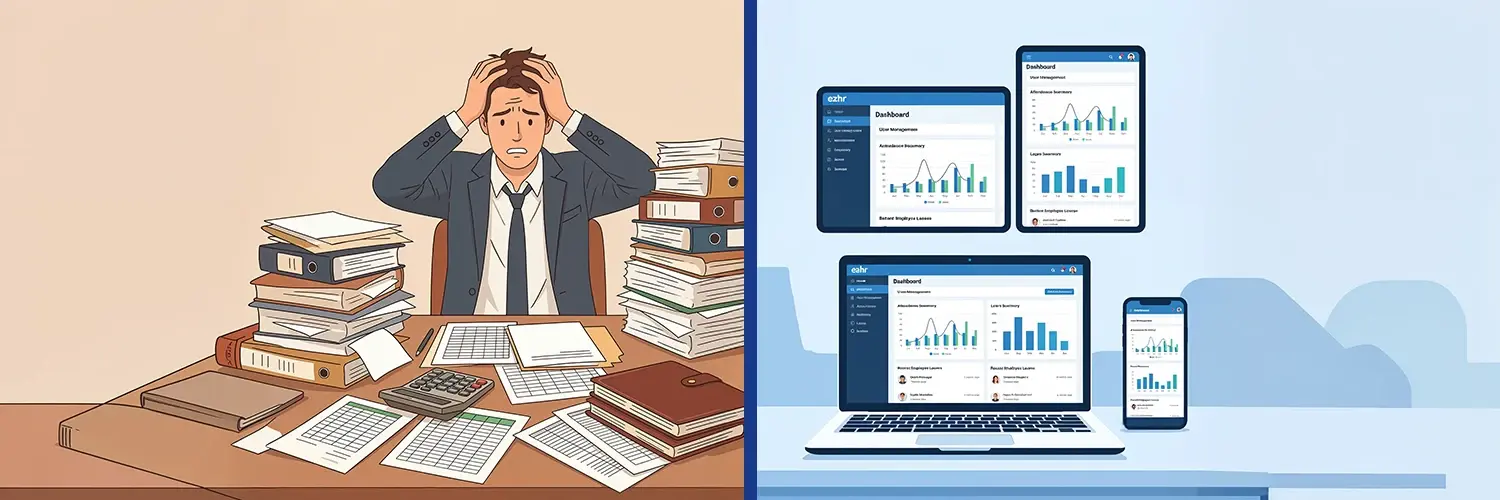
Digital Hyperlinks' EZ HR is a localized HR platform that centralizes employee data, device integration and payroll for Pakistani businesses. The platform supports real-time biometric attendance, attendance summaries and analytics, payroll automation, leave and shift management, employee self-service, and organization and device setup for multi-site operations.
EZ HR connects attendance and payroll workflows instead of requiring HR teams to repeatedly transfer information between registers, spreadsheets and separate systems. Its attendance and employee data capabilities also support reporting and reconciliation, helping businesses maintain clearer workforce records. For SMEs ready to move beyond manual HR, EZ HR provides a localized platform for attendance, payroll and employee management.
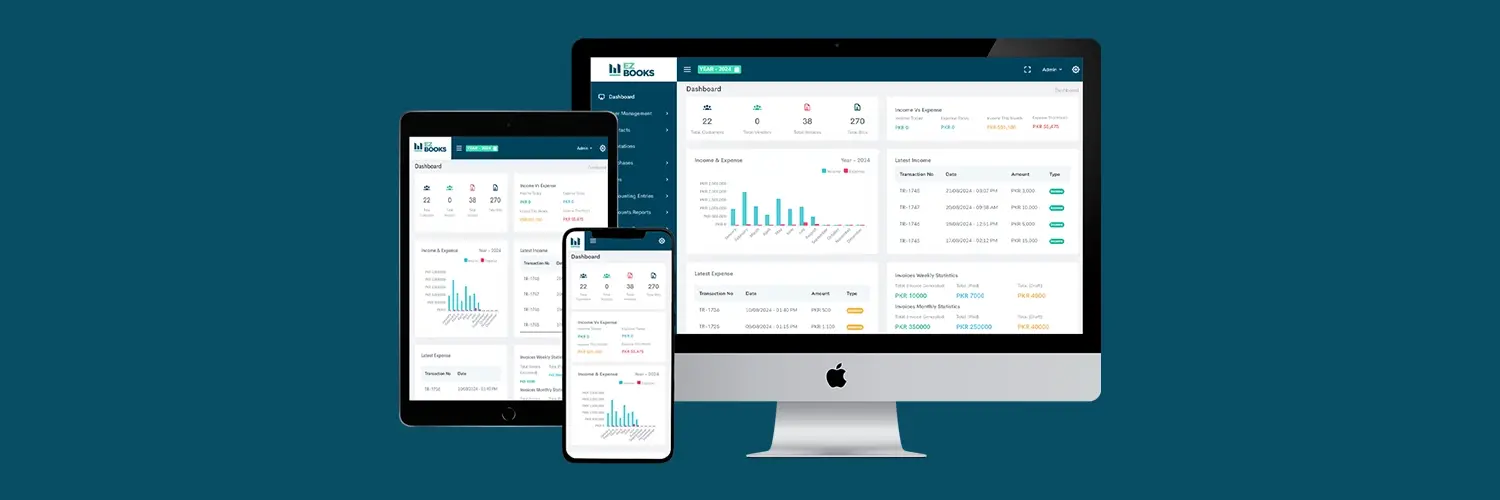
Beyond EZ HR, our full suite of business software products supports Pakistani SMEs across their digital transformation journey, including EZ Books for accounting, EZ Commerce for e-commerce operations, and EZ Club Master for club and membership management.
Conclusion
For Pakistani SMEs, moving from manual HR to HRIS Software is increasingly a practical step as teams, payroll and branch operations grow. A well-chosen system can connect employee management, biometric attendance, leave management, payroll automation and workforce reporting while reducing repetitive administration.
Digital Hyperlinks' EZ HR provides a localized platform for businesses looking to replace disconnected HR processes with a more centralized digital system.
Frequently Asked Questions
1. What is HRIS Software?
HRIS Software is a centralized system that manages employee records, attendance, leave, payroll and related HR processes digitally.
2. Why are Pakistani SMEs switching from manual HR to HRIS Software in 2026?
Growing workforce complexity, payroll workload, attendance issues, compliance needs and demand for employee self-service are encouraging SMEs to automate HR.
3. What problems does manual HR create for SMEs?
Manual HR can increase repetitive data entry, payroll errors, attendance disputes, reporting delays and difficulty managing employee records.
4. What is the difference between HRIS and HRMS?
HRIS generally focuses on core HR processes, while HRMS may cover a broader range of employee lifecycle functions depending on the vendor.
5. Can HRIS Software integrate with biometric attendance devices?
Yes, HRIS platforms can integrate with supported biometric devices to capture attendance data for reporting and payroll workflows.
6. Is cloud-based HRIS better than on-premise HR software?
Cloud-based HRIS can offer easier remote access, updates and scalability, but the best deployment model depends on a business's operational and security requirements.
7. How long does HRIS implementation take for an SME?
Implementation can take two to four weeks for many SMEs, depending on data migration, configuration, integrations, training and business complexity.
8. How much does HRIS Software cost for a Pakistani SME?
HRIS pricing varies by employee count, features, deployment model and implementation requirements, so SMEs should compare total cost against the processes and workload the system replaces.
Discover how our custom web software, digital platforms, and IT business solutions help organizations
streamline operations and scale faster. Explore our software development case studies showcasing real
results and innovation.